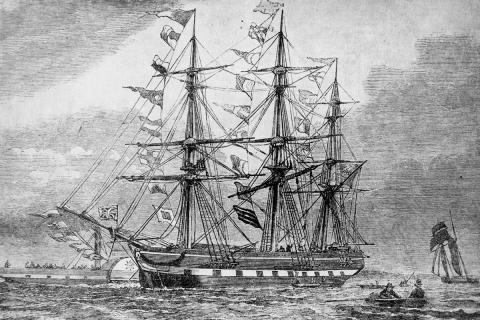
The barque Fortitude arrived in Moreton Bay in January 1849 after a four-month voyage from England. Chartered by the Scottish Presbyterian minister Dr John Dunmore Lang, the ship was the first of three vessels privately commissioned to bring free immigrants directly to the district.
Although modest in size, the Fortitude played a pivotal role in Queensland's history. Its legacy endures today in the name of Brisbane's Fortitude Valley and the many families, businesses and institutions that grew from the aspirations of those who arrived aboard the ship in 1849.
The voyage to Moreton Bay
Built in Scarborough, England, in 1842, Fortitude had previously operated as a merchant vessel before being selected for Lang's ambitious immigration scheme. Under the command of Captain John Christmas and accompanied by Surgeon Superintendent Dr Henry Challinor, the ship departed Gravesend on 14 September 1848 and reached Moreton Bay on 21 January 1849. The passengers included skilled tradespeople, labourers, farmers, merchants and families attracted by the promise of opportunity in the growing settlement.
The passengers and their contributions
Many of the Fortitude immigrants would go on to play important roles in the development of Queensland. Among them were Robert Cribb, who became a prominent businessman and politician; William Pettigrew, Queensland's first qualified architect and later Mayor of Brisbane; and Dr Henry Challinor, who became a respected physician and parliamentarian. Their contributions helped shape the economic, political and civic life of the emerging colony.
The legacy of the Fortitude
Today, Fortitude is remembered as one of Queensland's most significant immigrant ships. Unlike the Amity, which carried the officials and convicts who established the Moreton Bay settlement, Fortitude brought the free settlers who helped transform it into a thriving community.
After continuing in international trade for many years, Fortitude was eventually lost around 1866. Though the vessel disappeared from the seas, its place in Queensland's history endures as a symbol of migration, opportunity and the beginnings of modern Brisbane.
Chaseley, Lima and Fortitude passenger manuscript (n.d.) [Unpublished manuscript].
Davies AG (1935) ‘Immigration and the immigrant ships (Moreton Bay)’, Journal of the Royal Historical Society of Queensland, 2(6):304–326.
National Museum of Australia (n.d.) 'Founding of Brisbane', National Museum of Australia website, accessed 10 August 2026.