The Artemisia left Plymouth in August 1848 with 240 passengers, including skilled workers and young families. Many travelled under a British government scheme that offered free passage to workers whose skills were in demand in the Australian colonies.After nearly four months at sea, the ship reached Cape Moreton.
It was too large to cross the sandbar at the mouth of the Brisbane River, so passengers boarded the smaller steamer Raven for the final leg to Brisbane. Their arrival helped Moreton Bay grow in the years after it opened to free settlement.
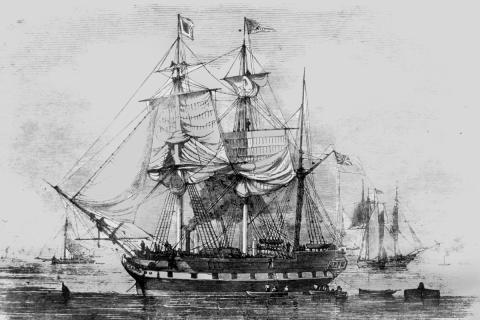
Free passage for skilled workers
To encourage migration, the British Government offered free passages to carefully selected workers whose skills were in high demand in the Australian colonies. Agricultural labourers, shepherds, carpenters, wheelwrights, mechanics and other tradespeople were actively recruited to help build communities, develop farms, and support a growing economy. Applicants were required to be of good character and were recommended for their sobriety, industry, and reliability. Successful migrants received passage, food, and accommodation for the voyage, although they had to provide their own clothing and pay a small deposit for children travelling with them.
The voyage from Plymouth
The vessel chosen for this task was the Artemisia, a new 492-ton barquentine built at Sunderland in 1847. Chartered by the Colonial Land and Emigration Commissioners and commanded by Captain John Prest Ridley, the ship departed Plymouth on 15 August 1848 carrying 240 passengers. Among them were skilled workers, young families, single men and women, and many children, all seeking new opportunities in a distant colony.
Conditions aboard the Artemisia were considered good for the time. The ship's upper deck was comfortably fitted out for wealthier passengers, while government-assisted emigrants received regular supplies of biscuits, beef, and pork. A reporter from the Illustrated London News even inspected the provisions before departure and praised their quality.
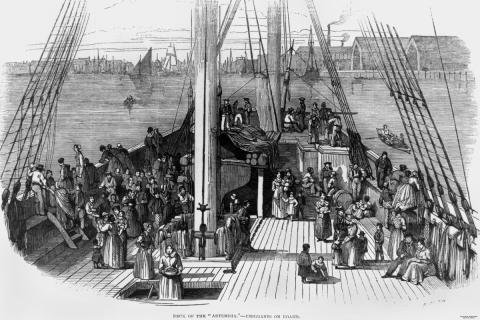
Arrival in Moreton Bay
After almost four months at sea, the Artemisia arrived off Cape Moreton in December 1848, becoming the first ship to bring government-assisted free immigrants directly to Moreton Bay. Because the vessel was too large to cross the sandbar at the mouth of the Brisbane River, passengers transferred to the smaller steamer the Raven for the journey upstream to Brisbane.
The arrival of the Artemisia was a pivotal moment in Queensland's history. Its passengers brought the skills, labour, and determination that the fledgling settlement desperately needed. The ship also carried news that more immigrants were on their way, including those aboard Dr John Dunmore Lang's Fortitude, which arrived the following month. Together, these newcomers helped transform Moreton Bay from a struggling outpost into a growing and confident community.
Davies AG (1935) ‘Immigration and the immigrant ships (Moreton Bay)’, Journal of the Royal Historical Society of Queensland, 2(6):304–326, accessed 10 August 2026.
Ryan S (2024) 'Arrival of the Artemisia: an “important event in the annals of Moreton Bay – an epoch to be often reverted to”', Genealogy Queensland Blogs, accessed 10 August 2026.
Wickham D (n.d.) The Artemisia: First Government Assisted Free Immigrants to Moreton Bay, Harry Gentle Resource Centre, Griffith University, accessed 10 August 2026.
Wood R (1990) ‘Artemesia: the first migrant ship to Moreton Bay’, Journal of the Royal Historical Society of Queensland, 14(5):181–189, accessed 10 August 2026.