In 1824, Governor Thomas Brisbane sought to establish a new northern penal settlement to separate repeat offenders from Sydney while supporting the expansion of British settlement in New South Wales.
To carry out this task, the brig Amity departed Sydney on 1 September 1824 under the command of Lieutenant Henry Miller, carrying around 70 passengers including soldiers of the 40th Regiment, convicts, government officials, livestock and supplies. Among those on board were Surveyor-General John Oxley, whose earlier explorations had identified Moreton Bay as a suitable location for settlement; Allan Cunningham, the King's Botanist; and Assistant Surveyor Robert Hoddle.
After an eleven-day voyage through rough weather, the Amity arrived at Redcliffe on 12 September 1824, marking the beginning of the first European settlement in what would become Queensland.
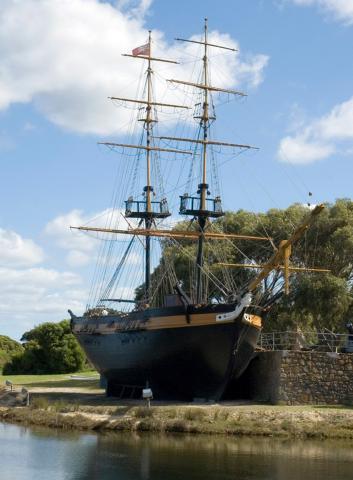
Establishing the Moreton Bay settlement
Upon arrival, settlers quickly constructed shelters, stores, barracks and other essential buildings. However, Redcliffe soon proved unsuitable due to limited fresh water supplies, poor farming conditions and its exposed coastal location.
These challenges became even more apparent on 26 September 1824, when a severe storm nearly destroyed the anchored Amity.
Following further exploration, Lieutenant Henry Miller carried out Governor Brisbane's instructions to relocate the settlement to the Brisbane River in May 1825. The new site offered a more reliable water supply, greater security and improved prospects for growth. From this settlement, the city of Brisbane would eventually emerge.
A vital link to Sydney
Beyond transporting the first settlers, the Amity became a vital link between the fledgling colony and Sydney.
Correspondence preserved by the Colonial Secretary records requests from the settlement for seeds, plants, tools and other essential supplies. The vessel also carried reports, maps and scientific collections that expanded knowledge of the Moreton Bay region.
Amity's legacy and final voyage
Today, the Amity is recognised as one of the most significant ships in Queensland's colonial history. Its voyages established the first European foothold in the Moreton Bay region and helped lay the foundations for Brisbane and the future colony of Queensland.
The brig's influence extended beyond Queensland. In December 1826, the Amity transported Major Edmund Lockyer and his party to Princess Royal Harbour, where they established the first European settlement in what would become Western Australia.
After more than twenty years of service, the Amity met its end in June 1845 while carrying livestock from Hobart to Port Albert. Caught in a severe gale in Bass Strait, the brig ran aground on Vansittart Shoals near Flinders Island and broke apart.
Although the vessel was lost, all aboard were rescued with assistance from local sealers, bringing the ship's long and remarkable career to a close.
Moreton Bay and More (2019) ‘The Amity drops anchor at Redcliffe, September 12, 1824’, Moreton Bay and More website, accessed 10 August 2026.
Pearn J & Tangney D (2017) ‘The “Amity” and the foundation of European settlement in Queensland’ , Queensland History Journal, 23(6):404–424, accessed 10 August 2026.