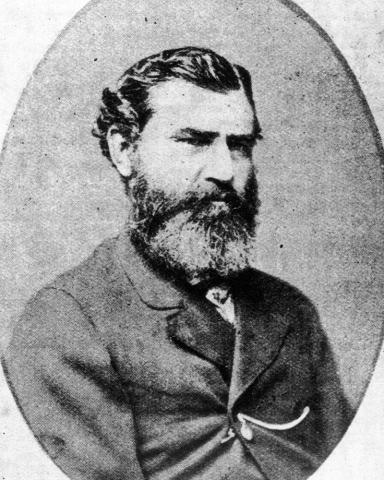
John Murray was a Scottish-born squatter and officer of the Native Police, established by colonial authorities to facilitate the expansion of European settlement across Queensland's frontier. Arriving in the Wide Bay-Burnett district as a pastoralist in the late 1840s, Murray later became one of the most prominent Native Police officers operating in regions including Port Curtis, Gladstone, the Calliope River, and the Fitzroy district. His role was to suppress Aboriginal resistance to colonisation and secure newly occupied lands for pastoral and settlement interests.
Murray appears regularly throughout the Colonial Secretary's Correspondence, where official reports, administrative records, and letters document both his career and the activities of the Native Police. These records reveal not only the mechanics of frontier administration but also the violence that accompanied colonial expansion. In one frequently cited report, Murray stated that Aboriginal people had ‘suffered severely’ and been ‘taught a lesson’, language that historians regard as illustrative of the punitive campaigns routinely undertaken by the Native Police against First Nations communities (Murray, 1851).
Contemporary accounts from the Gladstone district record that Murray's operations extended well beyond policing in the modern sense. Surveyors' diaries, settlers' correspondence, and official reports describe armed expeditions undertaken against Aboriginal groups resisting invasion of their country. In 1854, following conflict near survey camps at Port Curtis, Murray and his troopers were reported to have killed at least twenty-three Aboriginal people in a reprisal operation. Private observers recorded that local Aboriginal people subsequently avoided the settlement through fear of the Native Police. The violence was sufficiently well known that visitors to the district commented upon it at the time.
Today, Murray's legacy is deeply contested. By colonial administrators and settlers, he was often portrayed as an effective frontier officer. To many historians and First Nations communities, however, he stands as a symbol of the Native Police system and its role in the dispossession, killing, and disruption of Aboriginal societies across Queensland
Curr EM (1860) The Australian race : its origins, languages, customs, place of landing in Australia, and the routes by which it spread itself over that continent, Government Printer, Melbourne.
Fitzgerald JC (1854) Private diary of Captain John Coghlan Fitzgerald, HMS Calliope, April 1854, accessed 10 October 2026.
Gladstone Regional Council (n.d.) 'Police Creek' [PDF 381 KB], Local Heritage Register, accessed 14 October 2026.
Guenzler J (2025) 'The brutal history of Queensland's Native Mounted Police', National Indigenous Times, accessed 10 October 2026.
Murray J (3 February 1851) 'Original Correspondence', Sydney Morning Herald, accessed 5 October 2026.
Queensland State Archives (2025) Index: Correspondence - Aboriginal peoples, and Torres Strait Islanders, Queensland State Archives, accessed 10 October 2026.