Lying at the entrance to Moreton Bay, Stradbroke Island has long been a place of movement, encounter and change. Its shores have witnessed the arrival of European explorers and settlers, the ambitions of the colonial government, and the passage of ships carrying convicts, immigrants and goods into Moreton Bay.
Known as Minjerribah by its Traditional Owners, the island is part of Quandamooka Country, the lands and waters of the Quandamooka Peoples. The Nunukul (Noonuccal) and Gorenpul (Goenpul) peoples of Minjerribah, together with the Nughi people of neighbouring Moorgumpin (Moreton Island), have enduring cultural, spiritual and ancestral connections to the region.
James Cook sighted the island in 1770, naming Point Lookout but assuming it formed part of the mainland. Matthew Flinders later surveyed the area, and in 1823 John Oxley confirmed Stradbroke's status as an island. In 1827, it was officially named Stradbroke Island after the Earl of Stradbroke, while the settlement of Dunwich took its name from the family's subsidiary title, Viscount Dunwich.
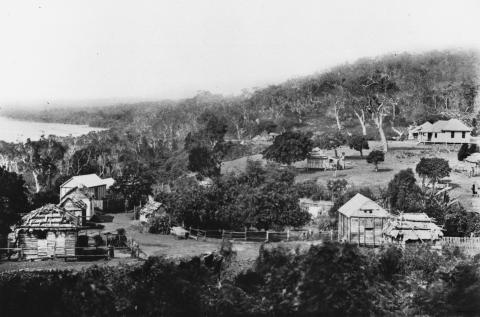
As the British colonial presence expanded in Moreton Bay, Stradbroke Island acquired an increasingly strategic role. The establishment of the Moreton Bay penal settlement in the 1820s created a need for safe anchorages, pilot services and places where larger ships could transfer their cargoes to smaller vessels for transport to the mainland. Dunwich developed as a supply and loading point, and convict labour was used to construct a waterfront causeway that remains an important part of the island's history.
During the nineteenth century, Dunwich became closely associated with important colonial institutions reflected in the Colonial Secretary's Correspondence. In 1850, it was proclaimed a quarantine station for Moreton Bay, intended to protect the growing settlement of Brisbane from infectious diseases carried by immigrant ships. The arrival of the Emigrant with typhus aboard soon demonstrated the human cost of this work. Passengers and crew were isolated at Dunwich, where many died, and the epidemic also claimed the lives of medical personnel who had tended to the sick. The quarantine station was subsequently transferred to Peel Island.
Dunwich then took on another role. From 1864, it housed the Dunwich Benevolent Asylum, which became a long-standing institution for people considered unable to support themselves. Its residents included older people, people living with illness or disability, and those experiencing poverty or social exclusion. Operating until 1947, the asylum reflected the social attitudes and welfare practices of colonial and later Queensland society.
Budde P (n.d.) 'Satellite settlements', Paul Budde History, Philosophy, Culture website, accessed 14 October 2026.
Ealing-Godbold C (2024) 'Islands in Moreton Bay as places of detention and separation', State Library of Queensland blog, accessed 10 October 2026.
Museums of History NSW (n.d) 'Moreton Bay Penal Settlement', Museums of History NSW website, accessed 14 October 2026.
Queensland State Archives (2021) 'The separation of North and South Stradbroke Island.', Queensland State Archives blog, accessed 07 September 2026.
Queensland State Archives (2025) Research guide to Dunwich and Eventide records, Queensland State Archives, accessed 14 October 2026.
State Library of Queensland (2012) 'Dunwich Benevolent Asylum provides significant evidence of Queensland history', State Library of Queensland blog, accessed 14 October 2026.