Situated on the banks of the Burnett River in the North Burnett region of Queensland, Gayndah developed during the pastoral expansion of the 1840s. The region lies within the traditional Country of the Wakka Wakka people. In 1843, pastoralist Henry Stuart Russell explored the area, and subsequent surveys and the establishment of large pastoral holdings brought increasing European occupation to the Burnett Valley.
A small settlement emerged at Norton's Camp, a river crossing that served the growing pastoral district. Known today as Gayndah, the settlement became an important point of communication and trade between outlying stations and the wider colony. By the late 1840s, it had developed sufficiently to support a post office, hotels and a court, reflecting the growing need for formal services and colonial administration in this expanding inland region. Gayndah was gazetted as a town in 1852 and became a municipality in 1866.
During the following decades, Gayndah developed as a regional centre, with schools, churches, newspapers and commercial businesses serving the surrounding population. However, its growth was uneven. Although nearby gold discoveries attracted attention to the wider district, the town did not experience the sustained expansion enjoyed by some mining centres, and the absence of a railway connection limited its development. A significant change came in the late 1800s, when local farmers recognised the agricultural potential of the fertile river flats. Citrus cultivation, particularly oranges and mandarins, gradually became central to the district's identity and economy.
Gayndah's history reflects the opportunities and challenges of colonial expansion beyond the coastal settlements: the occupation of pastoral land, the establishment of local institutions, the administration of a growing population and the search for sustainable industries. The Colonial Secretary's correspondence provides a way to explore these developments through the decisions of the colonial government. The correspondence relating to Gayndah reveal how officials responded to the practical needs of a distant township and how local concerns over land, infrastructure, policing and public services formed part of the wider administration of colonial Queensland.
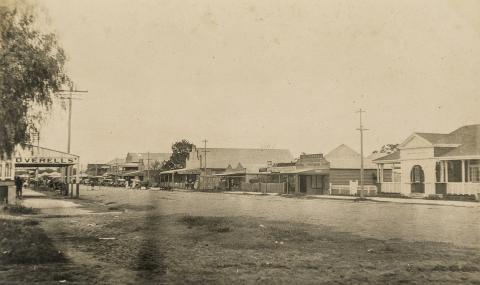
Brisbane Times (2008) ‘Gayndah: culture and history', Brisbane Times, accessed 10 October 2026.
Centre for the Government of Queensland (2018) 'Gayndah', Queensland Places website, accessed 10 October 2026.
Logan G (2025), 'John Sidney in the Burnett, 1849-1858: Businessman and author on the pre-separation Queensland frontier' Queensland History Journal, 26(3):230-247.
Williams TL (1965) ‘Early days of the Burnett’, Journal of the Royal Historical Society of Queensland, 7(3):634-638, accessed 10 October 2026.