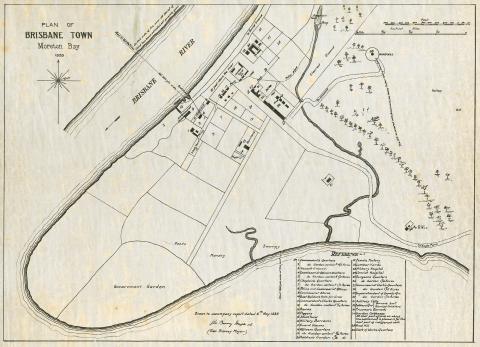
Established in 1824 on the banks of the Brisbane River, Brisbane Town began as a remote penal settlement of the British Empire. Its creation reflected Georgian ideas of punishment, deterrence and the reform of convicts through hard labour. Under the direction of the colonial government of New South Wales, the settlement was intended to confine those considered the most difficult to manage at the existing penal stations, keeping them at a distance from the wider free population. Its future remained uncertain, dependent on changing government policies and the decisions of governors, commandants, and other colonial administrators.
The settlement was established under the authority of Governor Sir Thomas Brisbane, following the exploration of Moreton Bay by John Oxley in 1823. Lieutenant Henry Miller became the first commandant, overseeing the arrival of the initial party of soldiers, officials and approximately 30 convicts in September 1824. They were soon joined by further prisoners and military personnel, who constructed the buildings, roads, workshops, and other facilities needed to sustain the settlement. Convict labour underpinned almost every aspect of its development, from clearing land and building accommodation to producing supplies and maintaining essential infrastructure. Their lives were governed by strict discipline, hard work, and the threat of punishment.
Military officers, clerks, medical staff, and other government employees were responsible for maintaining order and keeping the settlement functioning. Commandants exercised considerable authority over daily life, while the colonial administration in Sydney determined the settlement's broader purpose, resources and future. Decisions made by governors and officials could influence everything from the treatment of prisoners to the allocation of provisions and the construction of public buildings. These responsibilities created a constant flow of reports, requests, complaints, and instructions between Moreton Bay and the colonial government.
Yet Brisbane Town was not established on an empty landscape. The region was part of the traditional Country of Aboriginal peoples, including the Turrbal people around the Brisbane River and neighbouring Jagera peoples, whose connections to the land and waterways long predated British occupation. The arrival of the penal settlement brought dispossession, disruption and conflict as colonial activity expanded into Aboriginal Country. Encounters between Aboriginal people, convicts, soldiers and settlers were complex, shaped by resistance, adaptation, negotiation, and changing colonial power.
For its first 18 years, Brisbane remained a penal settlement, with its future tied to the priorities of the New South Wales government. The decision to open Moreton Bay to free settlement in 1842 marked a turning point. Convict-era buildings and infrastructure became part of a growing town, as settlers, merchants and tradespeople established new businesses and institutions. Queensland's separation from New South Wales in 1859 then transformed Brisbane into the capital of a new colony.
Australian Geographic (2025) 'Defining Moments in Australian History: Brisbane founded', Australian Geographic wesbite, accessed 10 October 2026.
National Museum of Australia (2024) 'Founding of Brisbane', National Museum of Australia website, accessed 10 October 2026.
Ryan S (2022) 'The Moreton Bay convict settlement: origins of Queensland', State Library of Queensland blog, accessed 11 October 2026.