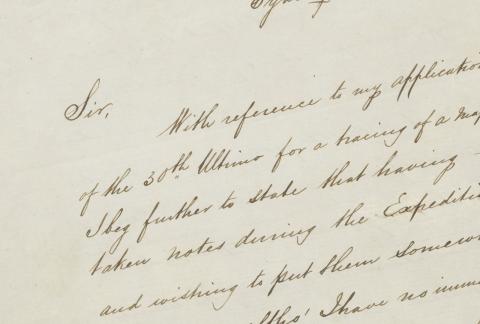
19th century handwriting can be very challenging to read, with the lettering style unfamiliar to modern readers. There are transcripts for documents in the Colonial Secretary's Correspondence, but you may like to read the original documents as part of your research.
The letters were written by many different people, with handwriting ranging from very neat to almost illegible.
Tips for reading historical handwriting
- Read the entire document first. Try to read the entire document to get a sense of the letter's subject. Reading out loud often helps. Some words that may not be legible may be worked out in context.
- Look for similar-looking letters. f and s, p and s, k and r, i and j, m and n, h and k, and s and l can all look the same.
- Watch for interchangeable letters. Writers sometimes used u and v, or y and i, interchangeably. You may also encounter abbreviations such as ye for the or yt for that.
- Expect spelling variations. Words were often spelled phonetically or according to the writer's interpretation. Surnames and place names may appear with different spellings, even within the same document.
- Be flexible with punctuation. Punctuation was often inconsistent. Sentences might begin without capital letters, capitals might appear mid-sentence, and letters such as t and i might be missing their usual marks.
- Recognise historical currency. Monetary amounts are commonly expressed in pounds, shillings and pence, using the symbols £, s. and d.
- Although: altho'
- Appealed: App'd
- Came free: CF
- Captain: Capt
- Child or children: Ch, Chn
- City: Cy.
- Commissioner: commr
- Commuted: Comd., Comm'd
- Commissary: Comm'y
- Company: Co
- Deputy: Dep'y
- Ditto or as above: D'o, "
- Emigration: Emig'n
- Enclosure: enc
- Et cetera: &c
- First class: 1C
- Gallon: gal, gall
- General: Gen'l
- Government: Gov't
- Governor: Govr
- Headquarters: Hd-Qrs., Head Q'rs
- Honourable: Honble, Hon'ble
- Instant: ins't
- In letter: In ltr
- Island: Isl'd
- Lady: L'y
- Lieutenant: Lieut, Lt
- Lord: L'd, Lo
- Magistrate: Magt
- Obedient: Obdt, Obed't, obt
- Officer in charge: OIC
- Petitioner: petr
- Proximo: Prox.
- Regiment: Reg't, regt
- Resident: Resd
- Roman Catholic: RC
- Sergeant: Sgt
- Servant: Servt, svt
- Superintendent: Superint't
- Ultimo: ultó
- Urgency: U'g'n'y
- January: Jany., Jan'y
- February: Feb'y, Feby, Feby.
- August: Augt.
- September: Sep'r, Sept'b'r
- October: Oct'r, Octr, Octr.
- November: Novr., Nov'r
- December: Dec'r, Decem'r
- Alexander: Alex'r
- Benjamin: Benj.
- Catherine: Cath.
- Charles: Chas
- Daniel: Da'l, D'l
- Edward: Edw'd
- Elizabeth: Eliz'th, Elizth., Eliz.
- Frederick: Fred'k
- George: Geo.
- James: Jas.
- John: Jno.
- Margaret: Marg't
- Michael: Mi'l, M'l
- Robert: Rob'rt
- Samuel: Sam'l
- Thomas: Thom., Thos.
- William: Wm.
- Edinburgh: Edinbro'
- England: ENG, Enf
- Ireland: Ire
- New South Wales: N.S. Wales
- New Zealand: NZ
- Norfolk Island: No. Island
Ancestry (n.d.) 'Tips for reading old handwriting', Ancestry, accessed 14 October 2026.
Jimenez A (2024) Interpreting 19th Century Documents: A Sample from the James Barton Longacre Collection. The Library Company of Philadelphia, accessed 14 October 2026.
Findmypast (2016) '11 Tips for Reading Old Handwriting'. Find my Past, accessed 14 October 2026.
Legacy Tree Genealogists (n.d.) 'Five Tips for Deciphering Old Handwriting', Legacy Tree Genealogists, accessed 14 October 2026.
Museums of History New South Wales (n.d.) 'Handwriting – tips for reading handwritten documents', Museums of History New South Wales website, accessed 14 October 2026.
Smithsonian Transcription Center (n.d.) 'How to Read Historic Handwriting', Smithsonian Transcription Center, accessed 14 October 2026.
Learn how to decipher 19th-century handwriting with practical tips and examples from the Colonial Secretary's Correspondence.