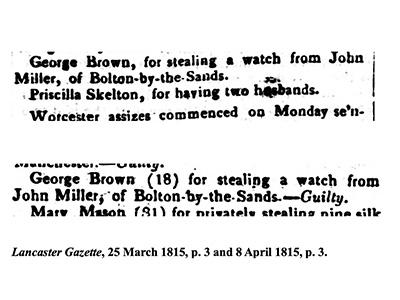
George Brown was one the most notorious runaways in the history of Moreton Bay penal colony. The records describe him as a ‘mulatto’ sailor and servant born in Sri Lanka. He was originally convicted of stealing a watch in Lancaster, England, in 1815, and sentenced to seven years transportation to New South Wales (Lancaster Gazette 1815; QSA 2017) .
Five escapes from Moreton Bay
After serving his time across New South Wales and Van Diemen’s Land, he received his certificate of freedom on 5 August 1824, only to reoffend within a year, earning him a stint at the Port Macquarie penal settlement (NSW Archives 1824). In 1828, following his release, he was convicted for theft in Sydney and sent to Moreton Bay to serve seven years, arriving on 24 January 1829, where he would spend much of the rest of his life (Sydney Gazette 1828).
At Moreton Bay, Brown proved to be one of the most persistent escapees: he absconded five times and received a series of floggings as punishment. On his first effort, he escaped for about five weeks before returning to the settlement. On 18 January 1831, though, he escaped for six months before returning. The following year, on 20 January 1832, he escaped for another six months before returning. And on 27 September 1833, he took off for almost one year and ten months. Lastly, he spent 1 January 1836 until 11 April 1837 on the run (QSA 2017).
Brown only survived such long periods on the run in an inhospitable climate by living with local Aboriginal people. They welcomed him into their community and Brown mastered their languages and customs. Brown’s skin colour also probably helped him gain their trust and facilitated his integration.
From runaway to bush constable
On 3 November 1838, Brown was discharged as free and permitted to stay on in Moreton Bay. The Commandant of Moreton Bay at the time, Sydney Cotton, recognised Brown’s talents, and on 15 March 1839, he wrote a letter to the Colonial Secretary, urging him to employ Brown as a ‘bush-constable’. The letter is revealing and worth quoting at length:
Brown is a man of color and a native of Madras: he lived several years in the Bush with the Blacks as a runaway from this Settlement. He there became conversant with the manners and customs of the natives and obtained that which he now possesses, a most remarkable influence over them. He appears to be a sort of Chieftan, his influence extending to a great distance in all directions from here. Putting to the test his oft repeated assurances, that he could bring the natives to be useful to Government, I have lately employed him on two occasions on the capture of Bushrangers, which he has found in the bush & assisted in capturing through the instrumentality of the tribes both to the northward and southward. Judging by these Circumstances I am [of the] opinion that Brown might be made a most useful servant to the Public; he has shown himself to be both willing and able to render essential services. He might perhaps be employed at first as a Bush-Constable with a small salary, slop clothing and rations, and on exerting himself with fidelity as a public servant according to the nature and degree of his services it might be held out to him that his salary would be increased.
Clearly, Cotton recognised how he could use Brown’s knowledge of indigenous culture and his influence among indigenous people to advance the interests of the government, particularly in policing the bush and capturing bushrangers. The initial distrust between Cotton and Brown is evident, as Cotton ends up ‘putting to the test’ Brown’s repeated assurances that he could be of service to the government. But Brown proved himself, and Cotton lobbied for his employment as a salaried bush constable.
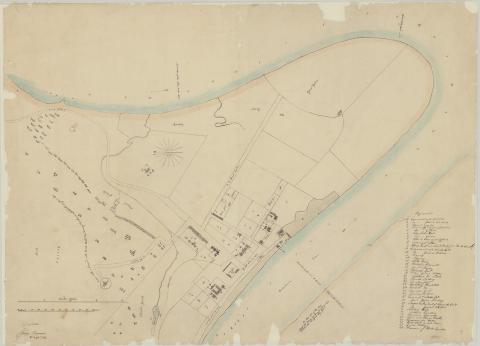
Indeed, on 3 July 1839, Cotton emphasised that Brown was ‘extremely useful to one not only in apprehending Bush rangers but in keeping the Blacks from committing robbery and laying with the Maize crops’. The authorities tasked Brown with drawing maps of the area of Brisbane, owing to his extensive knowledge of the local geography. A copy of his map of Brisbane remains in the State Archives of Queensland. Brown therefore used his skills to serve the penal officials, repressing challenges to colonial authority from outlaws and indigenous people.
From trusted constable to outcast
His position, however, was short-lived. When a new commandant, Owen Gorman, arrived at Moreton Bay in 1839, he was immediately suspicious of Brown and dismissed him from his position as bush constable. Gorman reported to the colonial secretary that Brown had behaved in ‘so insolent and disrespectful a manner’ to convince him that ‘he is of no further use as a Constable here’. Gorman was not only suspicious of Brown’s role as a cultural intermediary, but he was also probably motivated by racial prejudice, commenting that Brown was ‘nearly Black himself’ and that he ‘is likely to lead the natives astray instead of Seting [sic] a Good Example to them’ (Gorman 1840).
No longer in the service of the authorities, Brown went to live with the Aboriginal people, the Yuggera, near George Mocatta’s sheep station in Grantham. Here, Brown was subsequently accused of inciting an attack by the Yuggera on some shepherds at Mocatta’s station that resulted in the theft of thirty-nine sheep in October 1841.
In response to the raid, the local white community advanced on the local Aboriginal camp and, according to them, were met with violent resistance – two men were speared. Brown was found living with the Aboriginal people in the camp, and James Rogers, the superintendent of the sheep station, reported that the natives ‘had been perfectly quiet’ until Brown had started living among them when they then started to ‘plunder the Stations and threaten the lives of the men’.
Eyewitness Arthur Hodgson agreed with Rogers that Brown was the cause of the raid, claiming that he had ‘great influence with the Natives’. He requested that Brown be removed from the district of Moreton Bay, whatever the result of his trial (Rogers 1841; Hodgson 1841).
At his trial, Brown gave a markedly different account of the moment when the whites advanced on the Yuggera camp before dawn, describing it as a massacre, whereby the heavily armed white fired upon them for half an hour. Brown was released after serving a couple of weeks in gaol and his fate remains unknown (Evans 2007: 53; Richardson 2025).
A remarkable life
George Brown’s story matters because it challenges the assumption that early Queensland was made up of only white British settlers and Aboriginal peoples. Brown was originally from Sri Lanka, and his life linked Britain, Asia, and the Australian colonies, demonstrating the multicultural and truly global nature of the convict system.
Brown’s story also demonstrates the generosity and agency of Aboriginal people. Without their help, Brown would have perished. They welcomed him into their community, fed him and sheltered him, and passed on valuable knowledge and skills.
The relationships Brown forged with the Aboriginal people made him valuable to the colonial authorities, who employed him as a bush constable, interpreter and draftsman. His maps and geographical knowledge contributed to the early planning and development of Brisbane.
Yet, Brown occupied an ambiguous position. He assisted colonial expansion and policing, but he also maintained close relationships with Aboriginal people. When white settlers accused him of encouraging Aboriginal resistance, the knowledge and influence that had made him useful soon made him dangerous, and he was soon targeted by the colonial authorities.
Much of what we know about George Brown comes from the Colonial Secretary’s correspondence available in the State Library of Queensland. These valuable records allow historians to piece together a remarkable life and events that would otherwise have been largely lost.
Dr Sergio Lussana
Nottingham Trent University, UK
Cotton S (1839) ‘Letter 15 March 1839 from Sydney Cotton, one of the items from the Colonial Secretary's papers 1822-1877’, 33054, Colonial Secretary's papers 1822-1877, State Library of Queensland, accessed 23 November 2026.
Cotton S (1839) ‘ Letter 3 July 1839 from Sydney Cotton, one of the items from the Colonial Secretary's papers 1822-1877’, 33054, Colonial Secretary's papers 1822-1877, State Library of Queensland, accessed 23 November 2026.
Evans R (2007) A History of Queensland, Cambridge University Press, Cambridge.
Gorman O (1840) ‘Letter 13 August 1840 from Owen Gorman, one of the items from the Colonial Secretary's papers 1822-1877’, 33054, Colonial Secretary's papers 1822-1877, State Library of Queensland, accessed 23 November 2026.
Hodgson A (1841) 'Letter 27 October 1841 from Arthur Hodgson, one of the items from the Colonial Secretary's papers 1822-1877 to Colonial Secretary', 33054, Colonial Secretary's papers 1822-1877, State Library of Queensland, accessed 23 November 2026.
New South Wales State Archives (NSW Archives) (5 August 1824) George Brown, Certificate of Freedom, 067/2496, 4/4423, reel 601, New South Wales State Archives.
Queensland State Archives (QSA) (2017) Prisoners absconding data from Chronological Register of Convicts at Moreton Bay, 1824–1839, Queensland State Archives, accessed 6 May 2026.
Queensland State Archives (QSA) (2017) Prisoners: Original data data from Chronological Register of Convicts at Moreton Bay, 1824–1839, Queensland State Archives, accessed 6 May 2026.
Richardson JEM (2025) ‘“Other” Black Peoples: Rethinking Race and Settler Colonialism in Australia’s Northern Tropic’, Settler Colonial Studies, 15 (2): 416–418.
Rogers J (1841) 'Report 23 October 1841 from James Rogers, one of the items from the Colonial Secretary's papers 1822-1877’, 33054 Colonial Secretary's papers 1822-1877, State Library of Queensland, accessed 23 November 2026.
Sydney Gazette (22 October 1828) ‘Windsor Quarter Sessions’, Sydney Gazette, accessed 6 May 2026.
The Lancaster Gazette (25 March 1815) ‘Lancaster Assizes’, The Lancaster Gazette.
Discover the remarkable story of George Brown, a runaway convict who became a bush constable at Moreton Bay.