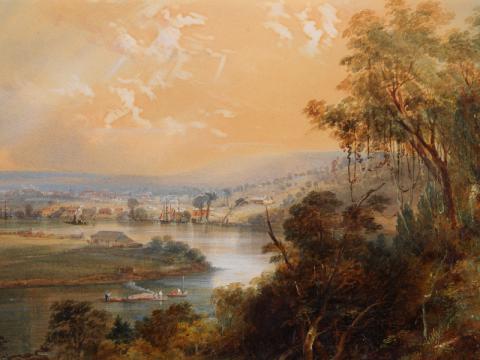
The people of Moreton Bay and the surrounding areas came from diverse backgrounds and for different reasons. Their experiences of the new colony, including harsh treatment, frustrations with lack of supplies and requests for clemency are all reflected in the correspondence. The Colonial Secretary lived in Sydney far removed from the day to day life in the penal settlement and colony.
Aboriginal people had lived in the Moreton Bay area for millenia before white settlement and included the Turrubul, Yuggera, Quandamooka, Gubbi Gubbi and Ningy Ningy peoples. They are referred to in the correspondence in ways that demonstrate their lack of agency and poor treatment by the government, colonists and the Native Police. They are often referred to using language and terms that that are considered inappropriate today.
Convicts and soldiers arrived with the establishment of the penal settlement at Redcliffe in 1824 and later Brisbane Town in May 1825 along with government officials to administer the settlement. In 1831 the population peaked with 1,241 people, of which 1,066 were convicts.
Missionaries arrived from 1838, with around 20 German missionaries recruited by John Dunmore Lang and Johann Gossner. They established the Zion Hill Mission in what is now Nundah, 7 miles north of Brisbane Town, with the purpose of converting Aboriginal people to Christianity.
Pastoralists from New South Wales moved north from the New England district when the penal settlement closed in 1839. This led the New South Wales government to declare Moreton Bay a district in 1842 and Darling Downs in 1843.
Assisted immigrants arrived to boost the numbers for manual workers, shepherds, tradesmen and domestic servants in Moreton Bay. The British and New South Wales governments established assisted immigration schemes such as the Colonial Land Emigration Commission to facilitate emigration to the colonies to expand the population. The first immigrants arrived on the Artemesia. Other emigration schemes included John Dunmore Lang’s Cooksland Colinization Company which transported migrants to Moreton Bay on 3 ships, the Fortitude, Chaseley and Lima.
Exiles was the name given to former convicts, used for labour by pastoralists, and were transported to Moreton Bay as cheap labourers from 1846-1850.
Indentured labourers from India began arriving in Moreton Bay in 1848 but they had been imported into other Australian colonies from the 1820s onwards. These workers performed hard labour on pastoral runs as settlers were unable to fill positions from British workers. In 1848 the first Chinese labourers arrived in Moreton Bay also to undertake shepherding and farm work.
German Immigrants also arrived beginning in the late 1840s due to labour shortages. The 1847-1856 Bounty Immigration to NSW Regulation of 7 April 1847 enabled importing of skilled labour from foreign places for the production of commodities such as wine, oil and silk that were not able to be filled by workers from Britain or its colony.
Davies AG (1935) 'Immigration and the immigrant ships (Moreton Bay)' Journal of the Royal Historical Society of Queensland , 2 (6): 304-326, accessed 17 November 2026.
Harry Gentle Resource Centre (n.d.) 'Queensland Timeline pre-1600s to 1859', Harry Gentle Resource Centre website, accessed 23 November 2026.
Raymond J (transcriber) (2010) '1847-1856 bounty immigration to NSW - regulation of 7 April 1847', Rootsweb, accessed 17 November 2026.
Rutian M (2020) Chinese Business History in Queensland - Pre gold rush: 1840-1850, State Library of Queensland blog, accessed 17 November 2026.
Ryan S (2022) The Moreton Bay convict settlement: origins of Queensland, State Library of Queensland blog, accessed 16 November 2026.
Shield M (2019) 'Crown Lands Commissioners – Moreton Bay and Darling Downs, 1842–56', Queensland Review, 26(1): 71–85, doi:10.1017/qre.2019.7.
Steele JG (1975) Brisbane town in convict days 1824-1842, University of Queensland Press, Brisbane.
Woollacott A (2015) Settle society in the Australian colonies, Oxford University Press, Oxford.
Meet the people who shaped Queensland's early colonial history.